

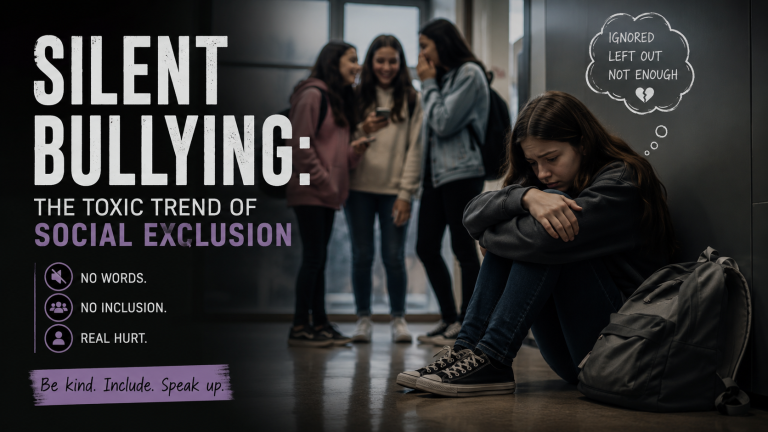
When most people hear the word bullying, they imagine physical aggression, verbal insults, or online harassment. However, one of the most damaging forms of bullying often goes unnoticed because it leaves no visible bruises and rarely appears in disciplinary reports.
It’s called silent bullying.
Silent bullying occurs when individuals are intentionally excluded, ignored, isolated, or made to feel invisible by a group. While it may appear harmless from the outside, social exclusion can have profound psychological consequences, especially for children, teenagers, and young adults.
In today’s hyper-connected world, where friendships and social status are increasingly displayed online, silent bullying has become one of the most common and toxic forms of social aggression.
What Is Silent Bullying?
Silent bullying refers to deliberate behaviors designed to isolate someone socially rather than attack them directly.
Examples include:
- Leaving someone out of group activities
- Ignoring messages in group chats
- Excluding a person from events or gatherings
- Refusing to acknowledge someone’s presence
- Encouraging others to avoid interacting with a specific individual
- Creating private groups that intentionally exclude one person
- Withholding information to make someone feel disconnected
Unlike traditional bullying, silent bullying often operates in the shadows. There are no obvious insults, threats, or physical confrontations. Instead, the victim experiences a gradual sense of rejection and isolation.
This subtle nature makes it difficult to identify and even harder to report.
Why Social Exclusion Hurts So Much
Human beings are inherently social creatures.
Psychologists have long recognized that the need to belong is one of our most fundamental emotional needs. Throughout history, belonging to a group increased our chances of survival. As a result, our brains are wired to respond strongly to rejection.
Research has shown that social exclusion activates some of the same brain regions associated with physical pain.
In other words, being ignored or excluded doesn’t just feel bad emotionally—it can literally hurt.
When exclusion becomes repeated and intentional, the effects can be severe.
Victims often experience:
- Loneliness
- Anxiety
- Low self-esteem
- Depression
- Social withdrawal
- Increased stress
- Difficulty trusting others
For young people, these effects can influence identity development and long-term emotional well-being.
The Digital Age of Silent Bullying
Technology has transformed how social exclusion occurs.
Years ago, a student might not discover they had been excluded from an event. Today, social media ensures they see every photo, video, and story.
A teenager opens Instagram and discovers all their friends attended a party without them.
A student notices everyone in the class is part of a group chat except them.
A coworker realizes colleagues have created a separate messaging channel where important conversations happen.
These digital signals of exclusion can feel constant and unavoidable.
Social media doesn’t just reveal exclusion—it amplifies it.
The Psychology Behind Exclusion
Why do people exclude others?
The reasons vary, but common motivations include:
Social Status
Excluding someone can be used as a way to strengthen group identity or establish social hierarchy.
Control
Some individuals use exclusion to manipulate relationships and maintain power within a group.
Peer Pressure
People often participate in exclusion because they fear becoming targets themselves.
Insecurity
Ironically, those who exclude others may be struggling with their own feelings of inadequacy or fear of rejection.
Regardless of the motivation, the emotional consequences for the victim remain significant.
Silent Bullying in Schools
Schools are one of the most common environments where silent bullying occurs.
Students may:
- Save seats for everyone except one classmate
- Exclude someone from projects
- Ignore a student during conversations
- Refuse to include them in games or activities
- Spread subtle messages encouraging others to avoid them
Because these actions often appear minor in isolation, adults may overlook them.
However, repeated exclusion can create an environment where students feel unwelcome, unsafe, and emotionally exhausted.
Silent Bullying in the Workplace
Social exclusion doesn’t disappear after graduation.
In workplaces, silent bullying can take forms such as:
- Leaving someone out of meetings
- Excluding coworkers from social events
- Ignoring ideas during discussions
- Withholding important information
- Creating informal cliques
Workplace exclusion can reduce productivity, damage morale, and contribute to burnout.
Employees who feel excluded are often less engaged, less innovative, and more likely to leave their jobs.
The Role of Social Media
Many social platforms unintentionally encourage comparison and social validation.
Follower counts, likes, comments, and visible interactions can make exclusion highly visible.
Features that seem harmless can sometimes become tools for silent bullying:
- Public friend lists
- Group chats
- Private communities
- Story sharing
- Selective tagging
The result is a culture where people can feel excluded even when no one directly says anything hurtful.
How to Recognize Silent Bullying
Silent bullying is often difficult to identify because it lacks obvious aggression.
Warning signs may include:
- Sudden withdrawal from social activities
- Avoiding school or work
- Increased anxiety around social situations
- Changes in mood or behavior
- Feelings of worthlessness
- Reluctance to participate in group settings
Recognizing these signs early can help prevent long-term emotional damage.
What Can We Do About It?
Combating silent bullying requires awareness and empathy.
Include Others
A simple invitation can make a significant difference.
Speak Up
If you notice someone being repeatedly excluded, don’t ignore it.
Encourage Open Communication
Create environments where people feel comfortable discussing social challenges.
Teach Empathy
Understanding how exclusion affects others can reduce harmful behavior.
Be Intentional Online
Before posting, sharing, or creating groups, consider who might be left out.
Small actions often have a bigger impact than we realize.
Conclusion
Silent bullying rarely makes headlines, but its impact can be devastating.
In an era where social connection plays a central role in our lives, exclusion has become one of the most powerful—and often overlooked—forms of harm. Whether in schools, workplaces, or online communities, intentionally making someone feel invisible can leave lasting emotional scars.
The good news is that inclusion is just as powerful.
A conversation, an invitation, a message, or a simple act of kindness can remind someone that they belong. And in a world where exclusion has become increasingly common, helping others feel seen may be one of the most important things we can do.